
The Feedback Loop Your Nonprofit Was Never Given
What a feedback loop is
If you’ve ever driven a car, you already understand feedback loops — you just may not have called them that.
When you drift toward the shoulder, you see it, you feel it, and you correct. The road gave you information, and you used it to adjust. That’s a closed loop: you act, the world responds, you find out what happened, and you use that to decide what to do next.
An open loop has no way back. You act, and you never find out what happened. Picture driving with your eyes closed. You can still steer — you just have no idea whether you’re staying in the lane.
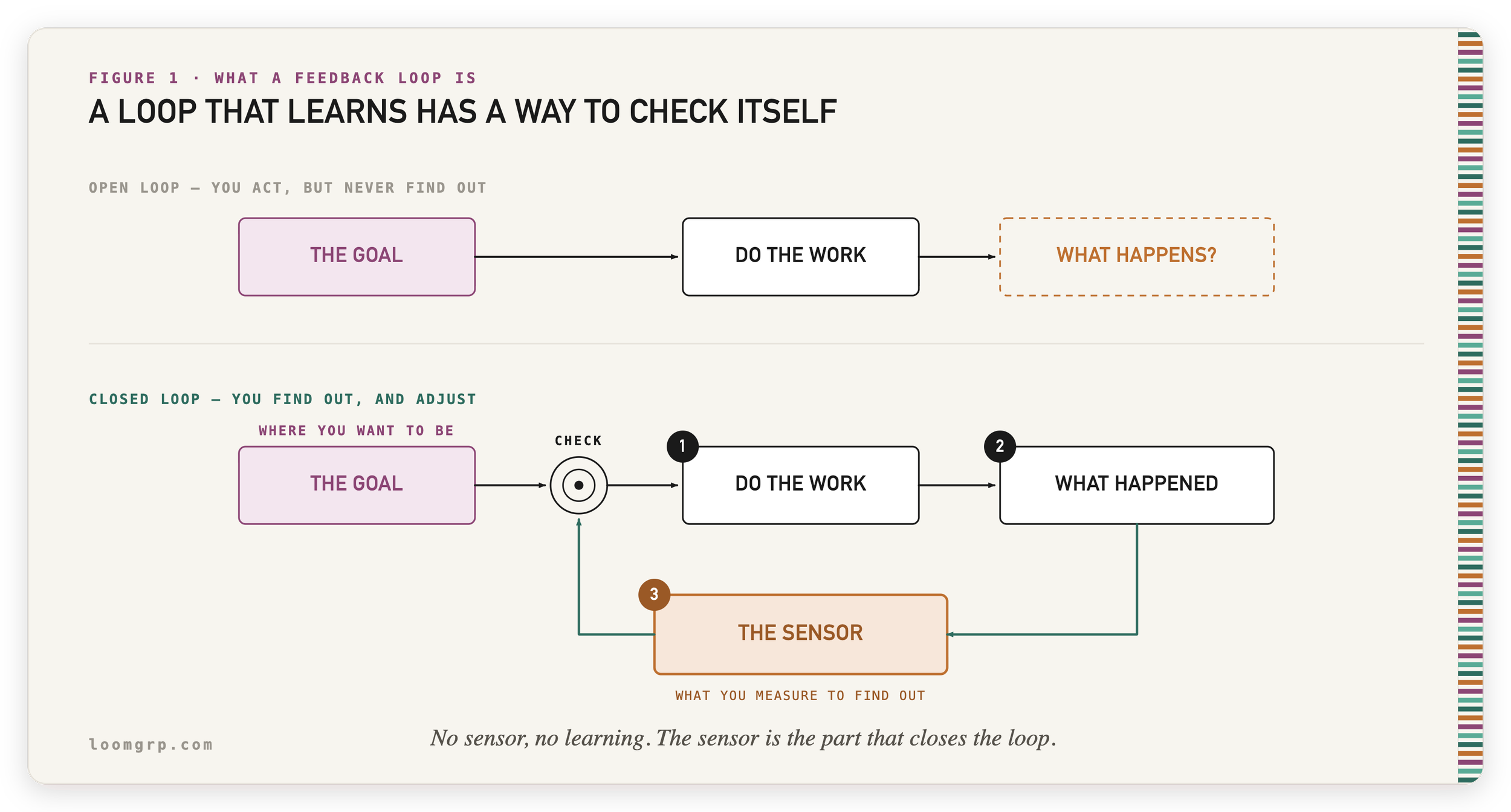
Two things make a closed loop work. You need a goal — where you’re trying to go. And you need a sensor — something that tells you whether you’re getting closer or further away, sometimes also referred to as a metric. Take away the goal and there’s nothing to steer toward. Take away the sensor and you’re driving with your eyes closed.
Most things that hold up over time are closed loops. Your body keeps its temperature steady this way. Engineers fly spacecraft this way.
For-profit businesses have a built-in sensor: revenue
Here’s something we say so often we’ve stopped hearing it: a business exists to make money. It’s not quite true, and the difference matters.
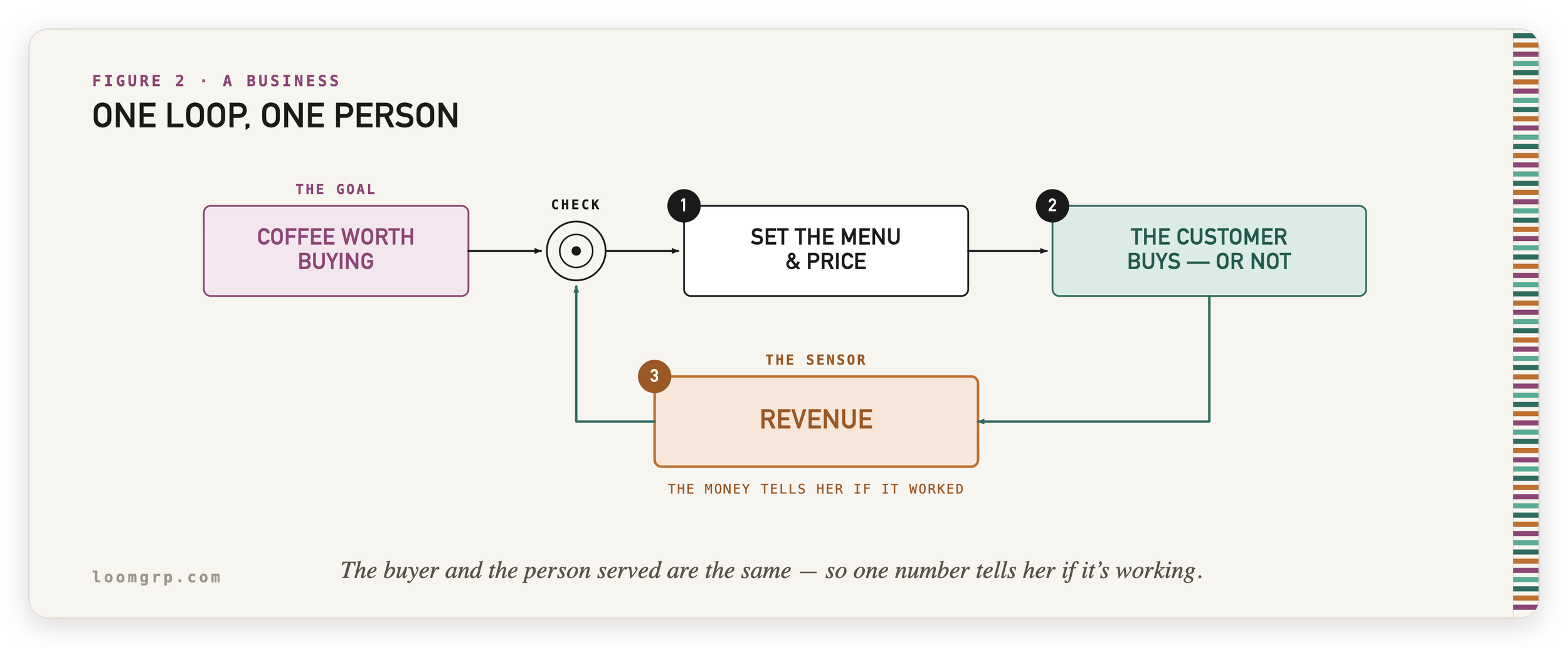
A business exists to make something people value more than the money in their pocket. That’s the goal — a product or a service worth more to someone than what they paid for it. Revenue is just the clearest sign that it’s happening. When someone buys your coffee, they’re telling you it was worth more to them than the five dollars. When they stop, they’re telling you it wasn’t. Revenue isn’t the goal. It’s the sensor — and it’s a good one, because the person handing over the money is the same person you’re trying to please.
A Small Business Example
A coffee shop adds a new drink. Week one, it sells. Week three, sales slip. The owner notices — because revenue dropped. She asks a few customers, looks at which days are slow, and figures out the drink is great hot and bad iced — and almost everyone is ordering it iced. She fixes the recipe. Sales come back.
That whole loop — try something, see what happens, learn, adjust — ran on one sensor. Revenue isn’t perfect. It tells you something changed, but never why. It can be gamed and it can fool you. But it closes the loop, so the business learns. And it works for one reason: the signal comes straight from the people the product is for.
The sensor can be revenue because the person paying and the person being served are the same person. One loop, one person.
Why that senor doesn’t work for non-profits
Here’s where it gets tricky — because nonprofits do have a money signal. Donations rise and fall. Grants get funded or turned down. Big donors renew, or they don’t.
The trouble is what that signal measures.
When fundraising goes well, it’s telling you something real: your fundraising team is good, your story is landing, your donor relationships are strong. Those things matter, and they’re worth tracking. But notice who’s sending the signal. The money comes from donors, foundations, and grantmakers — and almost none of them are the people your programs actually serve.
In a for-profit business, the person paying is the person you’re trying to help, so the money tells you whether you’re helping. In a nonprofit, the person paying and the person you’re trying to help are usually two different people. That splits your work into two separate loops. One loop runs through your donors: you raise money, you report back, they give again. That loop closes — you can feel it working. The other loop runs through the people you serve: you do the work, their lives change (or they don’t), and nothing comes back to tell you which. That second loop has no sensor. It never closes.
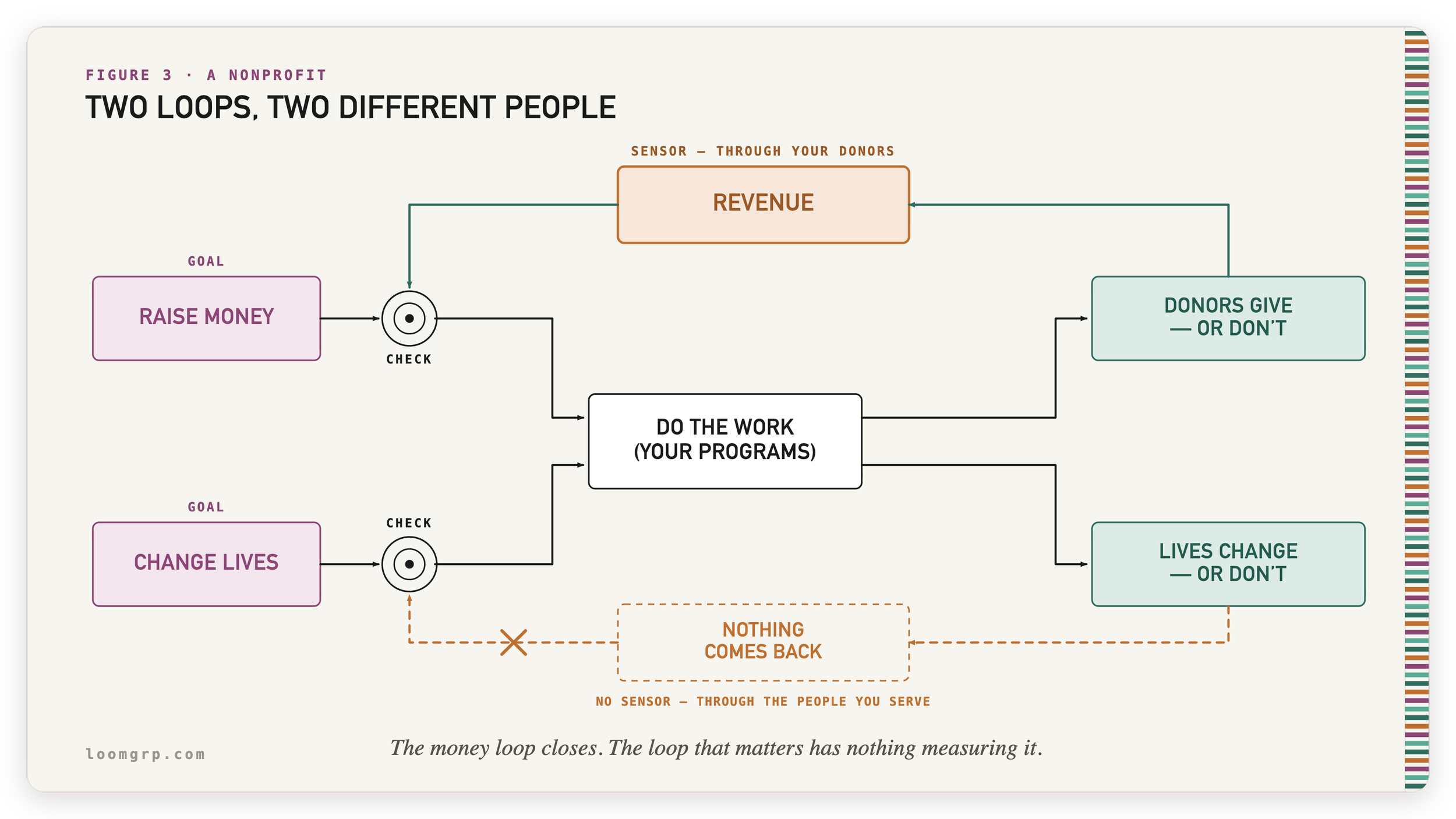
The money can only tell you how the funding side is going. It can’t tell you whether the family, the student, the patient, or the neighborhood on the other end is any better off.
An organization can raise five million dollars for work that barely helps the people it serves. Another can be doing quiet, life-changing work and still struggle to make payroll. Donor behavior tracks trust, relationships, story, timing, and a funder’s own priorities — not whether the work is landing. The sensor is real. It just tells you nothing about your impact.
There’s a version of this worth sitting with. Picture a young organization doing sharp, focused work on a hard problem. The early results look good. But they haven’t built donor relationships yet, and they can’t yet put their work into words funders respond to. So fundraising is a grind. From the outside, the money signal says this isn’t working. From the inside, the work says the opposite — and there’s nothing that carries the inside view to the outside. The organization fights for every dollar while doing some of the best work in its field.
For grantmakers: do you know what success actually looks like for the organizations you fund? Not how much they raised, or how many people they counted — but whether the people they serve are better off. It’s worth asking whether your own questions are steering grantees toward outputs or toward outcomes. The signal you ask for is the one they’ll chase.
None of this is a failure of leadership. Everyone is responding to the only signal they were given. That’s what makes it a problem with the system — and you fix a system by changing it, not by trying harder inside a broken one.
Counting outputs is the trap
So nonprofits reach for the next best thing. They count.
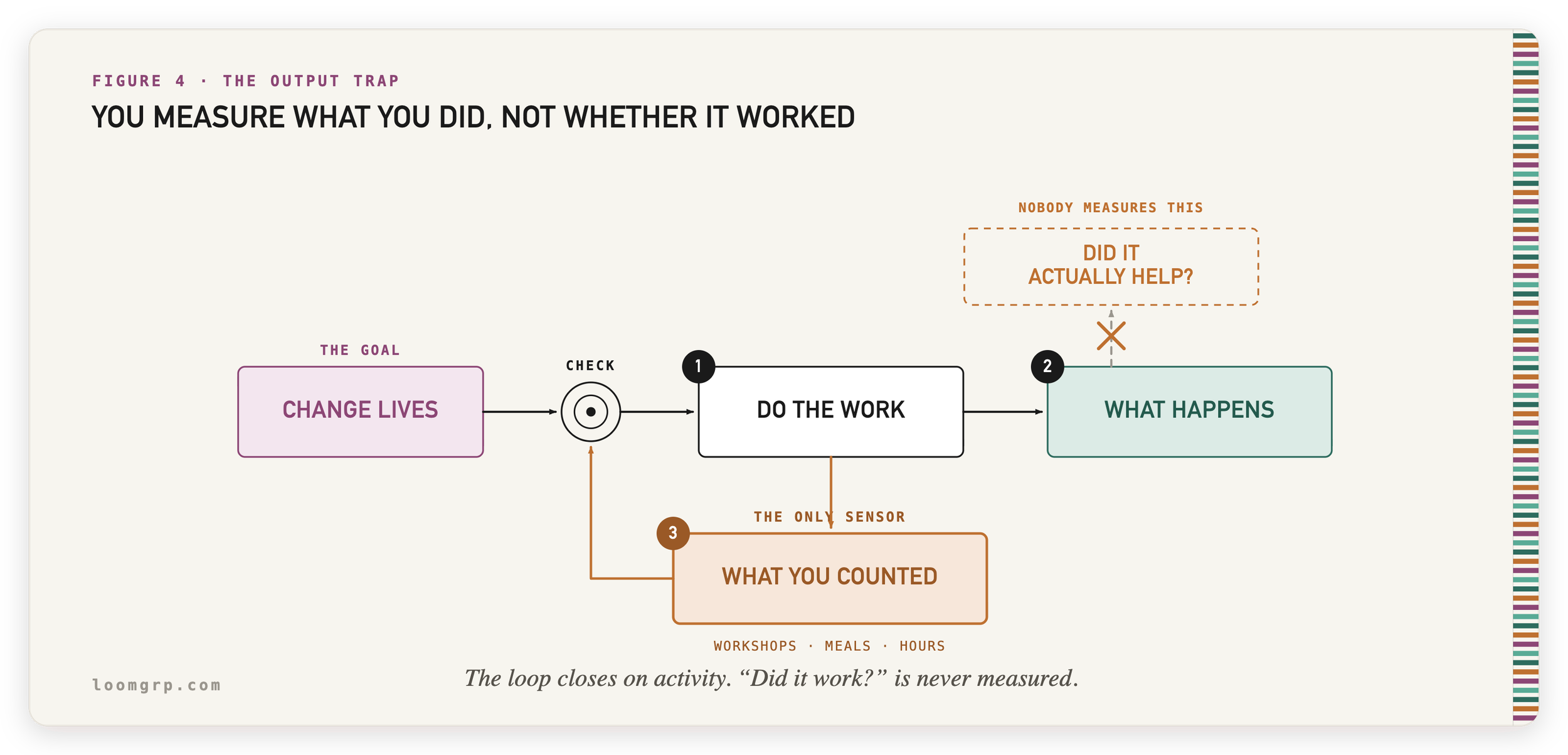
Most nonprofits aren’t flying blind on purpose — they’re measuring. They’re just measuring outputs: workshops held, meals served, clients seen, volunteer hours logged. Outputs are easy to count, easy to report, and — here’s the trap — exactly what most funders ask for. When a foundation asks “how many people did you serve?”, it isn’t trying to steer you wrong. It’s asking the best question the field handed it.
But the moment outputs become the thing you report, they quietly become the thing you chase. And you can hit every output number without changing a single life. A program that runs perfectly and helps no one will still make a beautiful annual report.
That’s the difference that matters: outputs tell you whether your team did the work. They don’t tell you whether the work did anything.
A job-training program that places 200 people a year has an output. A program that knows 73% of its graduates are still working in their field 18 months later — against 41% for a similar group who didn’t go through it — knows something else entirely. The first number says the program ran. The second says it worked. If outputs are your only sensor, you’re measuring how hard you’re swinging, not whether you’re hitting the ball.
How to build a sensor that closes the loop
Here’s the objection I hear from almost every nonprofit leader: “That sounds great, but you can’t really measure our impact. It’s impossible to prove.” I get it. Building proof from scratch — studies, data, controlling for everything — is overwhelming for a small team on a tight budget.
There’s a second objection, and it’s the honest one: “Too many things affect our clients. We can’t know how much of the change is us.” That part is true. You can’t cleanly separate your work from everything else in someone’s life, and you shouldn’t pretend to.
But follow the question one more step. If you really can’t tell whether your work matters — why are you doing it? Of all the times I’ve asked this, I’ve never once gotten “good point, I’ll stop.” What I get, instantly, is “No — I know it matters.” Good. How do you know? And then people start describing what they’ve seen. The clients who keep coming back. The teacher who said this year’s kids are different. The woman who called to say she finally got the job. Thirty seconds ago, measuring impact was impossible. Now they’re describing a sensor — they just hadn’t named it yet.
That instinct — the thing you’d point to if I pushed you — is where your sensor may already live. You don’t have to prove your slice of a messy world. You measure the thing you already treat as proof, and you lean on research that ties it to the outcome you want.
Because here’s the part that takes the pressure off: almost nothing important gets measured directly, even in science. We don’t determine if someone is sick by counting viruses in their body; we read a thermometer that measures their body temperature. We don’t watch the heart directly; we track blood pressure and cholesterol. Those are proxies — things we can actually measure that we already know are linked to what we care about. A good sensor is almost always a good proxy.
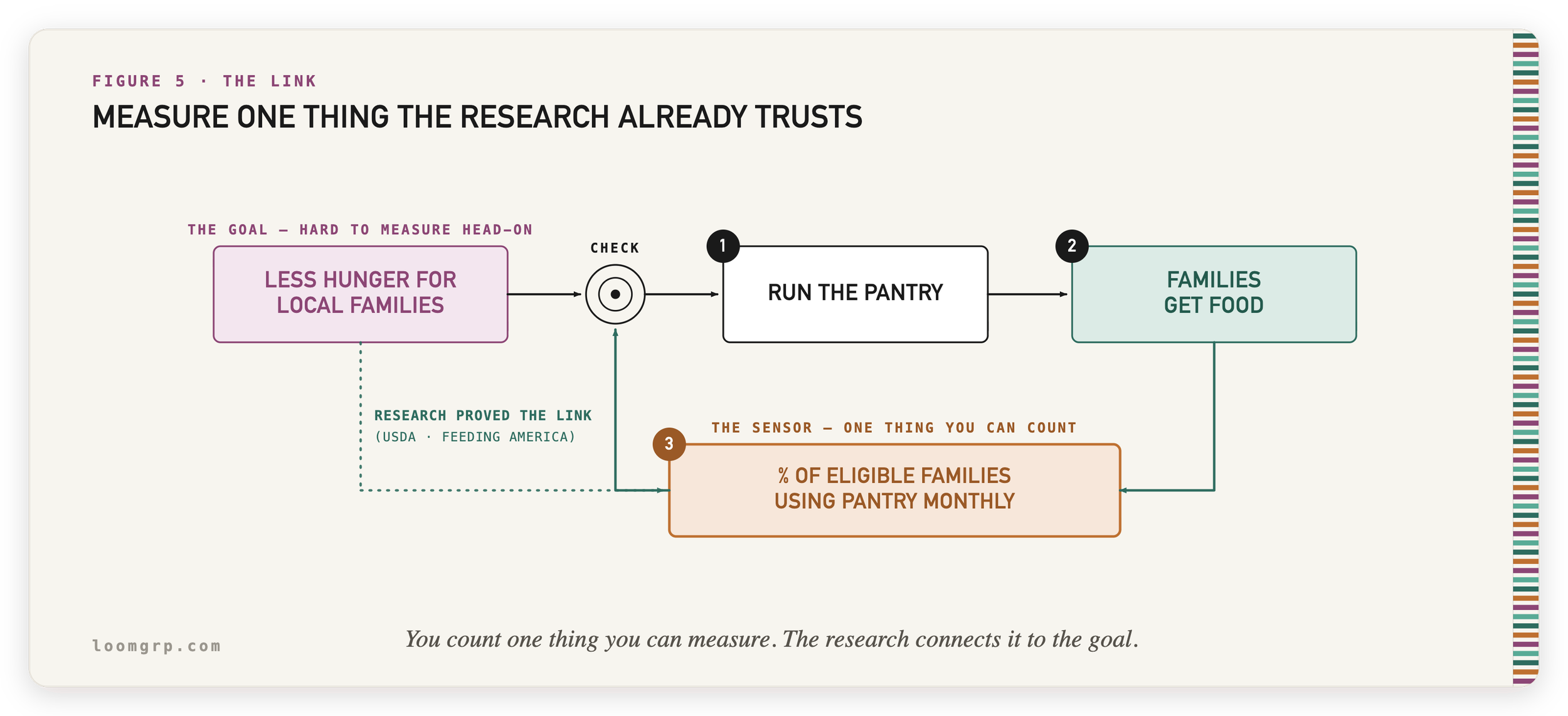
That’s your way in. Somebody has very likely already proven that if you do this, then that tends to follow — researchers, universities, decades of studies in your field. You don’t have to prove that link again. You just measure whether your own work is producing the near-term result that the research says leads to the outcome you’re after.
A Non-profit Example
Take a small food pantry in a rural county. Its goal: less hunger among families with kids in the local school district. It doesn’t have to prove that steady access to good food reduces hunger — the USDA and Feeding America settled that decades ago. So its sensor isn’t “pounds of food handed out,” which is just an output. It’s the share of families with school-age kids who qualify for free or reduced lunch and use the pantry at least once a month. The pantry isn’t re-proving the science. It’s checking whether it’s reaching the families the science says it can help.
There’s a fundraising payoff here, too. Moving from outputs to outcomes doesn’t just give you a better steering wheel — it gives donors a better reason to give. Outputs credit your program staff. Outcomes credit the whole organization: the strategy, the leadership, the people who kept it running. When you can show your work produces real change, you’re not asking a donor to fund a service. You’re asking them to invest in something that works. That’s an easier ask.
If this still feels like a lot, start with one goal and one sensor. You don’t need a dashboard. You need to know whether the thing you believe is happening is actually happening. Pick the one measure that would tell you fastest if it weren’t — and start there. And if you already have a dashboard full of numbers, ask a simple question of it: would any of these change if your programs stopped working? If not, you’re measuring effort, not effect.
The feedback loop can be built. It just has to be built on purpose.
Let’s build yours
This is the work Loom was built to do — helping mission-driven organizations build the feedback loop they were never given. If you’re curious what that could look like for yours, reach out at info@loomgrp.com or visit loomgrp.com.